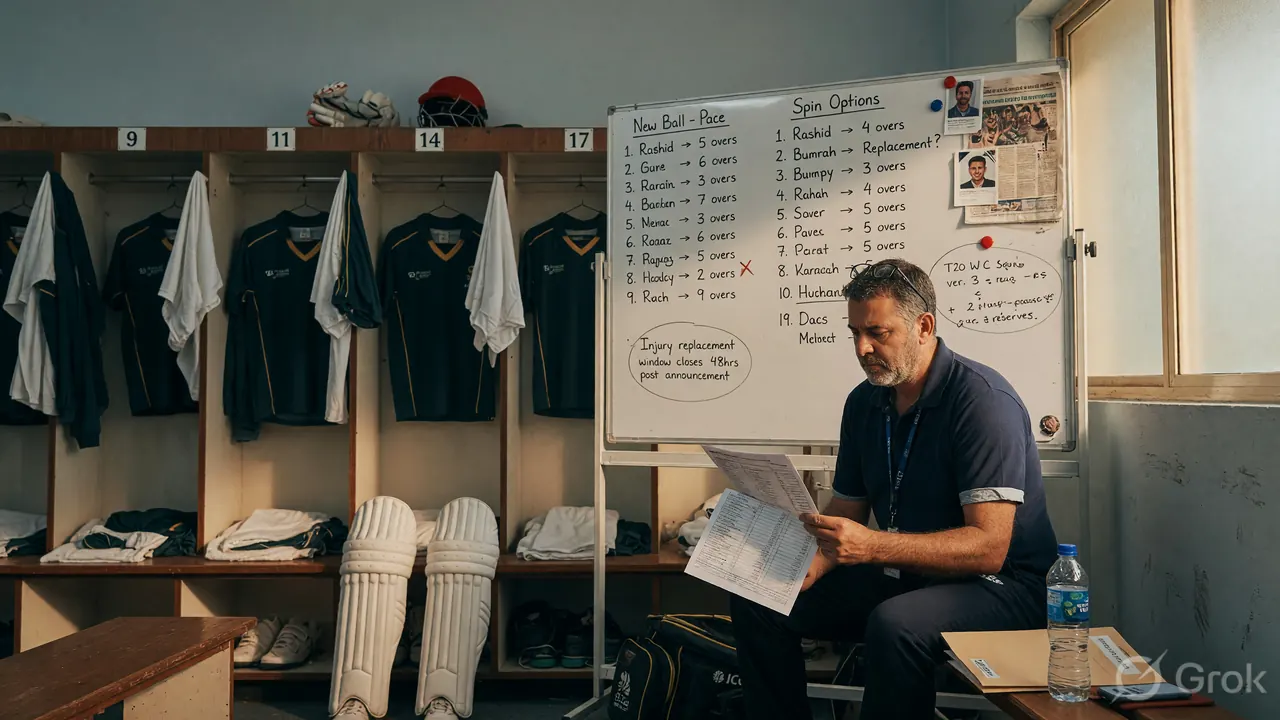
In the 15-player cycle, three calendar moments decide everything: the squad announcement, the ICC selection deadline, and the replacement-window opening after a tournament-start injury. Most readers read only the headline. The five questions below separate an opinion from a policy-aware read.
· CricTracker India Desk · Evergreen explainer
A T20 World Cup squad announcement is a 15-player contract between a national cricket board and the ICC. Each board nominates fifteen players by an ICC-published deadline that falls roughly two to three weeks before the opening fixture. The deadline is not advisory; it is a cut-off that locks the squad list into the ICC's central database and from there into every fixture sheet, broadcast graphic and match-official reference for the tournament. Reading the announcement correctly means treating the squad list as a final contractual output, not a working draft that can be revised at will the week before the first match.
Inside the 15, three layers of decision sit stacked. The first layer is the playing XI the captain and selectors are confident enough to name on day one. The second layer is a small group of role backups the selectors expect to rotate through the group stage. The third layer is the contingent: injury insurance for fast bowlers, batting depth if an opener loses form, and a wicketkeeper reserve if the starting keeper picks up a niggle. A reader who sees only the names is reading the contract. A reader who reads the layer structure is reading the decision.
The selection deadline runs in a fixed calendar window that the ICC publishes well in advance of each cycle. The window opens when the ICC's technical committee confirms the playing-condition document for the tournament, and it closes fourteen days before the opening fixture. Between those two dates, every board submits its final 15 through the ICC's event portal, and the submissions enter the official squad database that is used by match officials, broadcasters and the ICC's anti-doping sampling unit. Late submissions are not accepted for the opening window; boards that miss the deadline carry a player-eligibility risk that can be cleared only by an ICC Event Technical Committee ruling.
The deadline matters for readers because it creates a hard cut-off for the news cycle. A board that announces a 15-player squad three days before the deadline is not making an editorial decision; it is meeting a contractual clock. A board that announces a 15-player squad three weeks before the deadline is signalling something different: that the selectors want a public audition period, a pre-tournament conditioning window, or a contractual flexibility buffer for late injuries. Reading the timing of the announcement is, in many cases, more informative than reading the names inside it.
Once the opening fixture has been bowled, the squad list becomes a managed roster rather than a fixed contract. The ICC's replacement rule allows a board to substitute a player who is ruled medically unfit during the tournament, provided the medical evidence is signed off by the ICC's medical panel and the replacement is drawn from a published standby list that the board nominates alongside the original 15. The replacement can play in the next available fixture once the paperwork is logged; the replaced player is out of the tournament and cannot return even if they recover mid-cycle.
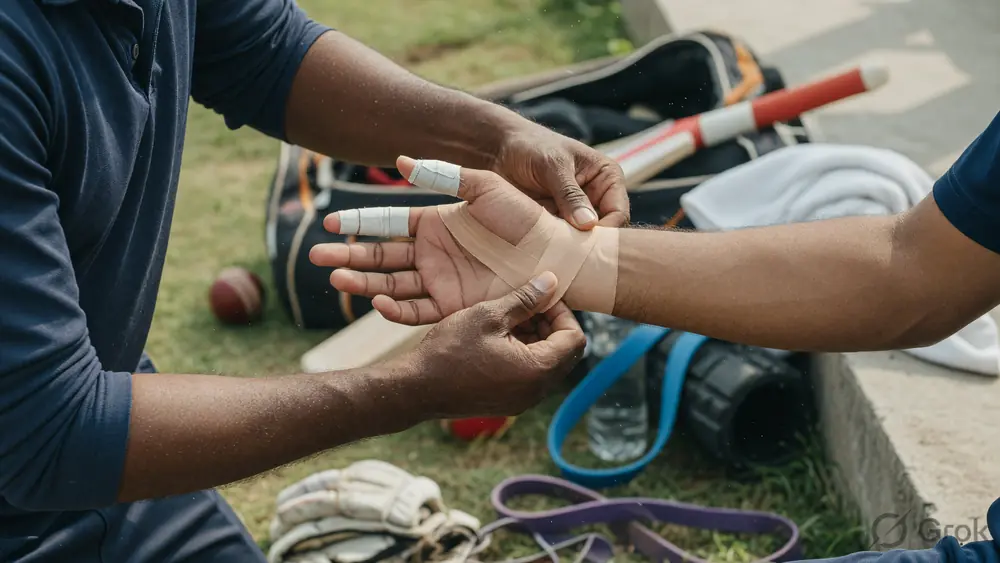
The medical review is the slowest of the three clocks. A board that calls a player unfit on day three of the tournament cannot put the replacement on the field until the ICC's medical panel has countersigned the diagnostic, and that panel operates on the tournament's match-day calendar rather than the board's travel calendar. The replacement-window opening is, in practice, a 48 to 96 hour lag between a board announcing an injury and a substitute appearing in the playing XI. Readers who see a "named replacement" headline should ask when the medical panel signed off, not just when the board announced the name.
Not every mid-tournament substitution is the same kind of policy event. The first category is the concussion substitute, which the ICC introduced in 2019 to address head-impact injuries: the substitute must be a like-for-like player, the match doctor's diagnosis is binding, and the on-field replacement is allowed only for the remainder of that single match, not the rest of the tournament. The second category is the COVID- or illness-related replacement, which is the rarest category and has its own additional PCR or rapid-test conditions that the ICC medical panel publishes for each cycle. The third category is the standard injury replacement, which follows the medical-panel + standby-list rule above and is by far the most common.
The distinction matters because the three categories move on different clocks. A concussion substitute can appear on the field within hours of a head impact, provided the match doctor is satisfied. A standard injury replacement requires the medical panel's signed diagnostic and a paperwork handoff to the ICC's event office before the substitute can be added to the squad list. The COVID category sits in between, with extra conditions layered on top of the standard flow. Readers who see "X is replaced by Y" without an explicit category should default to assuming the standard injury rule applies, because that is the most common case and the slowest to clear.
Most reader confusion about replacement rules comes from a single source: a board claiming a player is unfit when the medical evidence does not clearly support that claim. The ICC's medical-criterion test asks three questions, in this order. First, is the player's condition one that prevents them from performing the skills required for their listed role on the field? Second, is the condition one that is expected to last longer than the remainder of the tournament? Third, is the diagnostic supported by an independent specialist rather than only the board's own medical staff? A positive answer to all three is the threshold for an approved replacement.
The third question is where most disagreements happen. A board's own physiotherapist may have a clear diagnostic, but the ICC medical panel reserves the right to request an independent specialist review before clearing the replacement. The review is rarely public, which means readers see only the headline "X replaced by Y" without the diagnostic trail that produced it. The practical implication is that the policy-aware reader should treat the replacement headline as a fact and the medical reasoning behind it as a separate, often non-public document. If the board publishes its diagnostic summary, that is useful context. If it does not, the absence is not itself evidence of bad faith; it is the default operating state of the rule.
A reader who follows squad announcements will see boards drop a player on form grounds, not injury grounds, more often than they realise. The selection deadline does not require medical evidence; it requires only that the submitted player is fit to be considered for selection on match day. The form decision is a selectors' call, and selectors are not required to publish the reasoning behind the form decision. The published 15 may include a player whose recent domestic or franchise form is mediocre, because the selectors are weighing role balance, future-proofing and dressing-room factors that are not visible in the headline numbers.
The policy-aware reader can still draw useful inferences from the form call. If a board drops a player who was central to the previous tournament's XI, the call is rarely a fitness call; it is a tactical reset, a generational transition, or a response to a specific match-up problem the selectors have identified. If a board adds a player who has not played international cricket recently, the call is similarly tactical: a niche role, a powerplay option, a death-over specialist. Reading the form call is therefore a reading of the selectors' tactical priorities, not just of the player being dropped.
To make the contract structure concrete, consider a hypothetical 15-player squad from one board that has chosen three openers, four middle-order batters, two wicketkeepers, three fast bowlers, two spinners and one all-rounder. The captain sits inside the 15, and the selectors have flagged the third opener as the "standby" for the opening slot, not as a regular in the XI. The fast-bowling cohort of three has been built around one specialist death-overs bowler, one specialist powerplay bowler, and one swing bowler for the middle phase. The wicketkeeper cohort has been built around a starter and a reserve who can also bat in the middle order.
A reader who sees this shape can already predict where the injury pressure will fall. The fast-bowling trio is the thinnest cohort by workload and the highest injury-risk unit by the historical record; the third opener is the thinnest cohort by batting redundancy. If a fast bowler goes down mid-tournament, the board's standby list should be a fast-bowling all-rounder. If the third opener goes down, the standby should be a top-order batter who can also field in the inner ring. The shape of the standby list is therefore as informative as the shape of the published 15, because it tells the reader what failure mode the selectors are hedging against.
The standby list is the most under-reported piece of the squad announcement. Most reader coverage treats the 15 as the entire story and the standby list as a footnote, but the standby list is the clearest published signal of the selectors' risk model. A board that lists three fast-bowling all-rounders on the standby is signalling that it sees the fast-bowling cohort as the failure mode. A board that lists two wicketkeeper-batters on the standby is signalling that it sees the keeper slot as the failure mode. A board that lists a leg-spinner and an off-spinner on the standby is signalling that it sees spin bowling as the failure mode the pitch conditions will expose.
The standby list also reveals the depth chart the selectors are not willing to publish. Boards are not required to announce a preferred XI alongside the 15, and most choose not to. The standby list is the de facto depth chart, because it tells the reader which positions the selectors expect to need cover for and which they are confident enough to leave thin. A reader who wants to read selectors' risk model should compare the 15 to the standby list and ask, for every cohort, which position the selectors have left thinnest in the published 15 and which they have left thinnest in the standby list.
Take a hypothetical scenario: a fast bowler pulls a hamstring on the eve of the third group match. The board announces the injury on day one, the medical panel reviews the diagnostic on day one and day two, and the standby-list fast-bowling all-rounder is named as the replacement on day three. The replacement is added to the squad list and the match-official roster before the fourth group match, and the original bowler is officially ruled out of the rest of the tournament. The replacement can play in the fourth group match onwards, and is eligible for the Super 8 and knockout phase if the team progresses.
This is the standard flow. The variations the policy-aware reader should watch for are the ones where the medical panel asks for additional independent specialist review, where the standby list does not contain a like-for-like replacement, or where the original bowler's diagnostic is contested by the board's medical staff. Each variation delays the replacement by 24 to 72 hours and reshapes the selectors' options for the next fixture. Readers who see a delay between the announcement of the injury and the announcement of the replacement should ask whether the delay is in the medical review, the paperwork handoff, or the standby-list selection.
The squad announcement and injury replacement system is a rule set, not a moral claim, and the policy questions that surround it are more durable than the on-field story. First, when did the board submit its 15-player list to the ICC, and was the submission inside the published deadline window? Second, did the standby list include at least one player for each role cohort that the published 15 carried, or did the selectors leave a cohort thin? Third, when an injury replacement was announced, was the medical review signed off by the ICC's panel or did it require an additional independent specialist review? Fourth, did the replacement come from the published standby list, or did the board request a special exception? Fifth, did the board publish any part of the diagnostic reasoning, or is the medical record sealed under the ICC's medical-confidentiality framework?
The five questions are not rhetorical. Each maps to a specific published ICC playing-condition rule, and each can be checked against an ICC press release, an Event Technical Committee ruling, or a board media note. A reader who can answer the five questions after a squad announcement is reading the policy. A reader who can answer them after an injury replacement is reading the diagnostic chain. A reader who cannot answer either is reading a headline.
This is an evergreen explainer about how T20 World Cup 2026 squad announcements and injury replacements are read. It does not name a current event, player, injury, score, quotation or verified statistic. It will be reviewed when the ICC publishes the next playing-condition document for the next men's senior white-ball tournament, and when the next women's senior T20 event locks its format. The rule set is the durable element; the specific squad decisions are the part that changes with every edition.
Each national board nominates a 15-player squad to the ICC by the published selection deadline, with an additional standby list that sits outside the 15 and can be drawn on for mid-tournament replacements. The 15-player structure has been the standard since the 2022 men's cycle and has been carried forward into the 2026 cycle.
The ICC publishes a specific calendar window for each cycle, with the deadline typically falling fourteen days before the opening fixture. The exact date varies by tournament; readers should check the ICC's event page for the precise deadline of the relevant cycle rather than rely on a default window.
Outside the medical-replacement rule, the 15-player list is locked once submitted. Boards cannot add or remove players at will after the deadline; changes are permitted only through the medical-replacement flow, which requires ICC medical-panel sign-off and a standby-list substitution.
The concussion substitute rule was introduced in 2019 to address head-impact injuries. A like-for-like substitute is allowed only for the remainder of the affected match, not the rest of the tournament, and the match doctor's diagnostic is binding. The substitute must come from the published squad or the approved standby list.
The standby list is a separate list of players nominated by each board alongside the published 15. It is the de facto depth chart for medical replacements: when a player is ruled unfit, the replacement must come from this list unless the ICC Event Technical Committee approves a special exception. The list is published but rarely highlighted in reader coverage.
The board's medical staff produces the initial diagnostic. The ICC's medical panel reviews and countersigns the diagnostic before any replacement is approved. The panel may also request an independent specialist review before clearing the replacement, particularly when the diagnostic is contested or the player's role is critical to the team's balance.
For the broader T20 World Cup 2026 hub, including the semi-final schedule, the post-tournament India squad retrospective and the Super 8 ladder explainer, see the T20 World Cup 2026 hub. For ongoing match coverage and tournament news, see the live matches section and the news desk.
